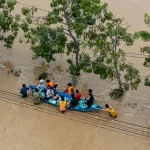


The Typhoon Kalmaegi impact continues to devastate Southeast Asia after leaving at least 193 people dead in the Philippines and Vietnam. The storm, packing winds of up to 149 km/h (92 mph), is now barreling west toward Cambodia and Laos after ripping through central Vietnam on Thursday night.
In the Philippines, Kalmaegi unleashed relentless rain that triggered deadly landslides and flash floods. Entire neighborhoods, particularly in Cebu and other central provinces, were wiped out. Survivors described the storm as unlike any they had experienced before, with homes swept away and roads buried under thick mud and debris.
Rising Death Toll and Massive Displacement
The Typhoon Kalmaegi impact has been catastrophic. The Philippines’ death toll surged to 188, with 135 people still missing. President Ferdinand Marcos Jr. declared a national state of emergency as emergency teams raced to reach remote and submerged areas. Thousands sought refuge in evacuation centers, while soldiers and volunteers worked around the clock to clear roads and restore communication lines.
In Vietnam, five people were confirmed dead, and tens of thousands were evacuated from coastal towns as powerful winds uprooted trees, tore roofs off buildings, and flooded entire communities. The Vietnamese military deployed over 260,000 personnel, 6,700 vehicles, and aircraft to aid rescue and relief operations.
Cambodia and Laos Brace for the Storm
As the Typhoon Kalmaegi impact moves toward Cambodia, authorities have issued alerts warning of potential flooding in low-lying areas. Vietnam’s Prime Minister Pham Minh Chinh urged officials to ensure that “no one is left hungry or cold” as emergency supplies are distributed to affected families.
With record rainfall, rising waters, and widespread destruction, Kalmaegi has become one of the region’s deadliest storms in recent years. Communities across Southeast Asia now face the long, painful process of rebuilding homes, restoring livelihoods, and recovering from the immense tragedy left in its wake.