

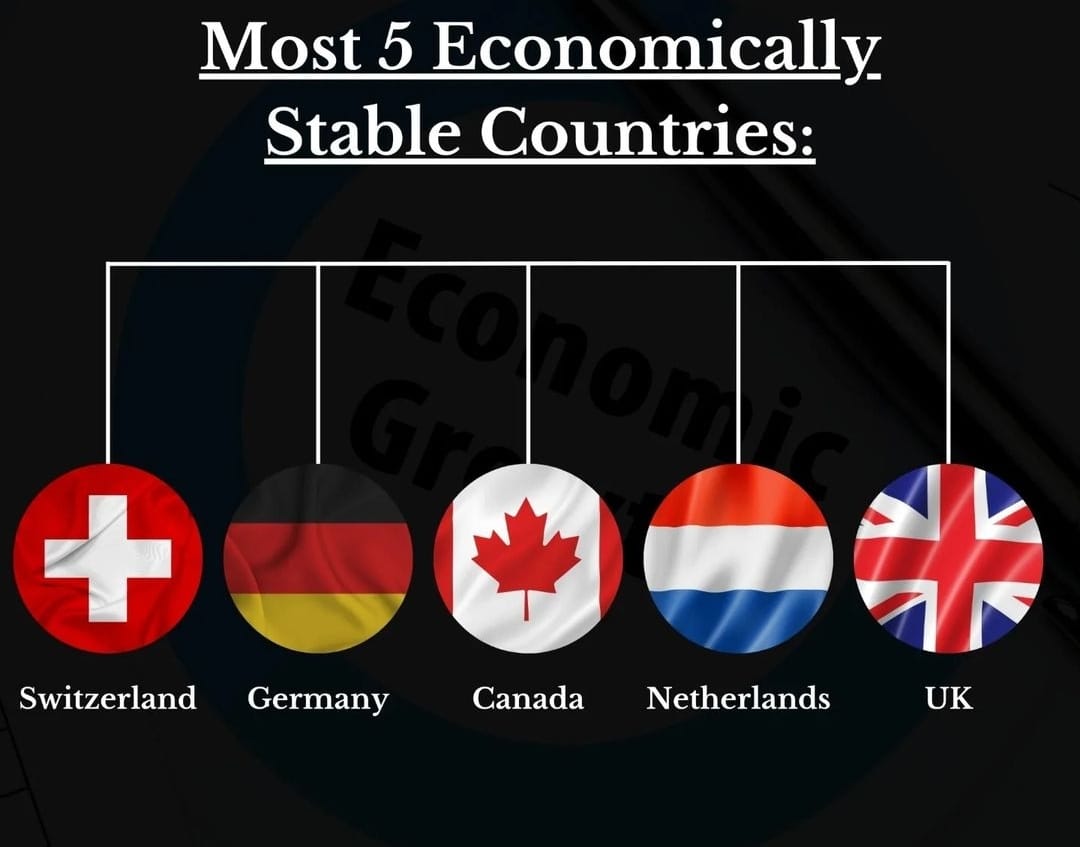
In a global environment marked by uncertainty, several nations stand out for their economic stability, strong institutions and resilient financial systems. These countries combine sound fiscal management, low debt, diversified economies and credible governance. For individuals, investors and businesses seeking safe environments, understanding which nations rank as most stable helps in decision-making about where to invest, locate operations or live. In this article we explore five of the world’s most economically stable countries, detailing the factors that underlie their stability, what makes them resilient and how they compare across global benchmarks.
1. United Arab Emirates (UAE)
The United Arab Emirates tops many rankings of economic stability thanks to its diversified economy, sovereign wealth funds and strategic geographic position. The government has aggressively invested in infrastructure, logistics, tourism and renewable energy to reduce reliance on hydrocarbons. Moreover, fiscal buffers and a flexible currency regime support the domestic economy during external shocks. These structural strengths give the UAE a level of stability uncommon among oil-exporting countries.
Financial governance also plays a key role. The UAE operates transparent corporate regulations, attracts foreign capital with ease and promotes free zones that enable global business. Institutional frameworks around banking, regulation and trade further reinforce this position. Because the nation carefully manages its public finances and investment strategy, it remains a top destination for capital seeking predictable returns and low political risk.
2. Switzerland
Switzerland exemplifies economic stability through its fiscal discipline, high productivity and international orientation. Its public debt remains comparatively low, and the country consistently posts trade and current-account surpluses. The Swiss franc serves as a safe-haven currency in turbulent times, underlining Switzerland’s financial credibility.
Beyond macro indicators, Switzerland benefits from a highly skilled workforce, advanced manufacturing and a large service sector. Political institutions are stable, regulatory frameworks are robust and corruption levels are low, all of which support confidence from global investors. The country’s engineering-driven economy and conservative fiscal policy give it structural resilience against external shocks.
3. Germany
Germany is Europe’s economic powerhouse and a model of industrial strength combined with fiscal responsibility. Its economy features a broad manufacturing base, strong exports and a well-developed social framework that supports long-term stability. Germany’s federal structure, rule of law and strong regulatory systems reinforce economic predictability.
The country continues to invest in advanced industries, digital transformation and green technologies. Its banking sector remains well-capitalised and supervision remains rigorous. While demographic challenges and energy-transition costs are real, Germany’s institutional foundations provide a level of economic stability other large economies struggle to match.
4. Canada
Canada offers significant economic stability built on natural-resource wealth, diversified services and strong governance. Its currency, the Canadian dollar, participates in global markets but the country also maintains fiscal safeguards and prudent debt levels. Transparent institutions and a legal environment favourable to business help maintain stability.
Additionally, Canada benefits from strong trade links with the United States, a stable political system and a predictable regulatory regime. These factors make it attractive for investors looking for stable jurisdictions in North America outside the U.S. While commodity-price swings present risks, Canada’s macro-policy framework absorbs those shocks more effectively than many peers.
5. Japan
Japan’s economy may face long-term demographic pressures yet it continues to rank among the world’s most stable due to its large, diversified economy, technological leadership and disciplined institutions. The yen remains an important global currency, and Japan maintains strong trade balances in key industries.
The nation features advanced infrastructure, robust corporate governance practices and a workforce skilled in innovation. On the fiscal side, high public debt is a concern, but the government’s measured approach to policy and Japan’s external asset position contribute to overall economic resilience. For businesses and investors seeking a stable environment in Asia, Japan remains among the top choices.
Common Attributes of Economically Stable Nations
These five countries share several key attributes that underpin their stability. First, they maintain credible and transparent governance systems that foster investor trust and reduce policy uncertainty. Second, they diversify their economies rather than rely heavily on a single sector or commodity. Third, they keep fiscal and monetary policy frameworks anchored, with manageable public debt and consistent inflation control. Fourth, they build institutional strength across banking regulation, corporate governance and legal infrastructure. Finally, they engage in global trade and investment with open systems that adapt to change.
What Stability Means for Individuals and Investors
For investors, stable economies provide lower risk of abrupt policy shifts, currency crises or structural collapses. They tend to offer better protection of property rights, dependable infrastructure and long-term growth potential. For individuals considering relocation, employment or starting a business, such countries deliver higher levels of predictability in daily life—from healthcare and education to legal systems and labour markets.
Challenges and Future Considerations
Even the most stable countries face challenges. Global supply-chain disruptions, demographic shifts, climate change and technological disruption all pose risks. Stability must therefore be maintained proactively through investment in skills, infrastructure and adaptation mechanisms. Countries described here must continue evolving to preserve their status in a rapidly changing global environment.
Although no economy is immune to global shocks, these five nations illustrate how economic stability can be built and sustained through consistent policy, institutional strength and strategic diversification. For those seeking safe havens, reliable growth or solid foundations for business or living, they represent best-in-class environments in today’s world.