

Taliban bans books by women
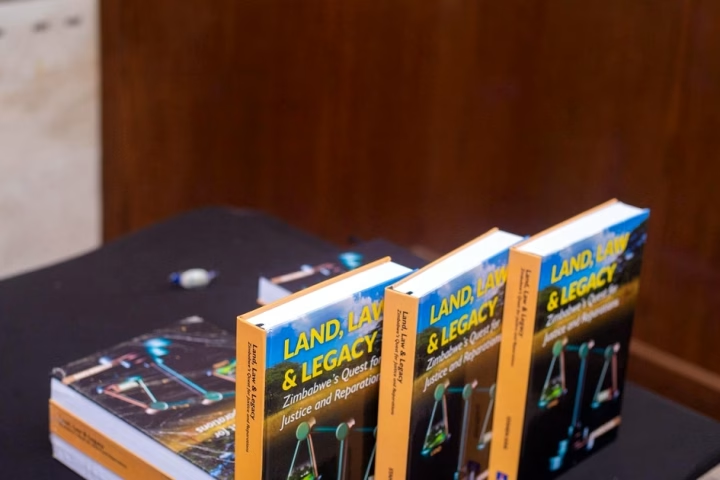
The Taliban government has ordered Afghan universities to remove books written by women from their curriculum, intensifying its campaign to control educational content. Around 140 books authored by women, including works like Safety in the Chemical Laboratory, were deemed to violate “Sharia and Taliban policies” and are now prohibited.
Alongside this, 18 university subjects, including topics on gender, development, and women’s sociology, have been banned, sparking outrage among educators and human rights groups. The latest decree comes as part of a broader effort by the Taliban to restrict the scope of higher education in the country.
Restrictions on women’s education
The Taliban’s return to power in 2021 has already resulted in a severe crackdown on women’s rights, particularly in education. Women and girls are barred from attending school beyond the sixth grade, and midwifery courses were shut down in late 2024, further limiting their opportunities for professional development.
The banning of books by women, particularly those focused on women’s roles in society, underscores the Taliban’s misogynistic policies. These policies aim to suppress female voices in academia and culture, effectively erasing women’s contributions from public discourse.
International reaction and implications
Zakia Adeli, a former deputy minister of justice and one of the banned authors, expressed little surprise at the Taliban’s latest move. She said, “Given the Taliban’s track record, this was expected. When women are not allowed to study, their ideas and writings are inevitably suppressed.”
The impact of these restrictions is widespread. Educators are struggling to fill the gaps left by banned content, which has historically connected Afghan universities to global academic networks. A professor from Kabul University said, “Removing these books creates a void in higher education.”
The future of Afghan education
The Taliban’s banning of educational materials and subjects reflects a broader ideological agenda, aiming to align the country’s educational system with their interpretation of Islamic law. However, this has led to concerns that Afghanistan’s educational landscape will become increasingly isolated from global academic trends.
As the Taliban bans books by women and suppresses knowledge related to human rights and gender studies, Afghan students and educators continue to face significant challenges in pursuing a well-rounded education.