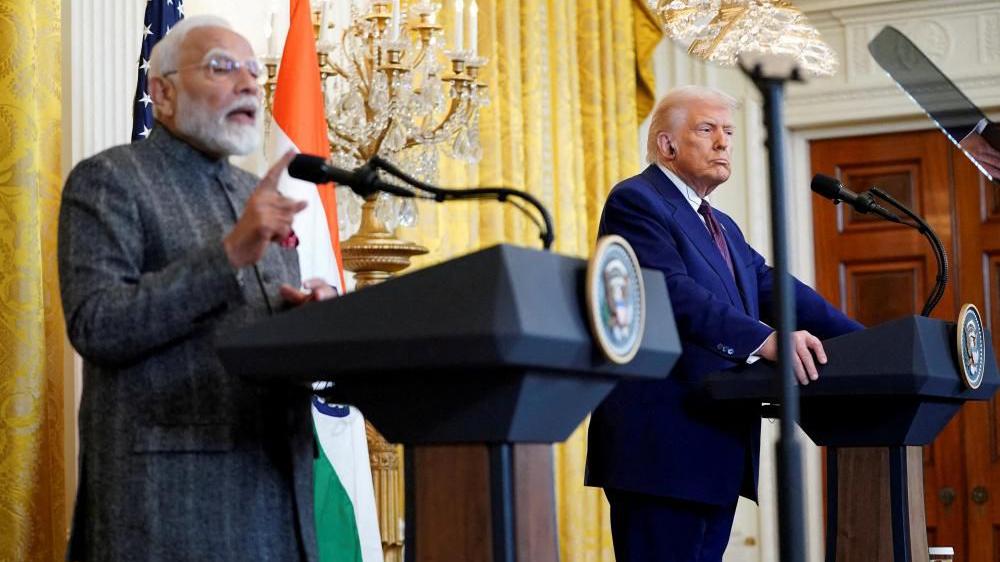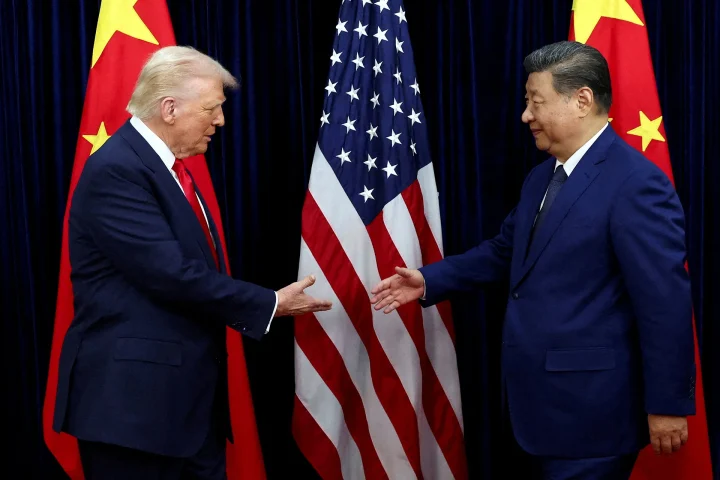


India US relations have grown tense as Donald Trump increases pressure on New Delhi over its oil and arms purchases from Russia. He initially threatened 25% tariffs on Indian goods, later raising the figure to 50%, alongside other penalties. This pressure stems from India’s role in BRICS, which Trump sees as an anti-American bloc, and its continued trade with Russia.
By using tariffs and sharp public criticism, Trump aims to limit India’s economic independence. His goal is to align India’s policies with US strategic priorities. He has also demanded India open its agricultural market to US products such as genetically modified corn, soybeans, dairy, and fruit. These demands threaten India’s domestic producers. Moreover, his insistence that India replace Russian oil with costlier US alternatives adds to economic strain.
Trump’s language has been blunt. He has called India’s economy “dead” for resisting US alignment and suggested tariffs of 150–250% on pharmaceutical exports, a vital sector. His deportation of undocumented Indians via military aircraft and his claims of halting India-Pakistan airstrikes during Operation Sindoor have further angered New Delhi. Modi declined a White House dinner after learning Trump planned to host Pakistan’s army chief at the same event.
These moves reflect American exceptionalism. The US often works to ensure that India’s ambitions remain secondary to its own global dominance. Critics warn that friendship with America can be like the parasitic Cuscuta plant—once it wraps around its host, it eventually weakens it.
India has long promoted strategic autonomy, a legacy of its non-aligned movement roots. BRICS membership and trade with Russia and Iran reinforce this image. Yet defense agreements with the US have slowly eroded that autonomy. Increasingly, Washington treats India as a “vassal state” expected to align its foreign policy with American directives.
Examples are telling. In 2019, India ended Iranian oil imports under US pressure. Now it faces demands to reduce Russian oil purchases. Modi’s tilt toward the West, while rejecting China’s Belt and Road Initiative (BRI) and the Regional Comprehensive Economic Partnership (RCEP), has cut India off from key economic frameworks. The 2020 Galwan Valley clash with China widened the gap further.
This strategy leaves India exposed. US tariffs loom while trade deficits grow. Despite a GDP of US$3.5 trillion in 2025, India cannot yet match the economic or military reach of the US or China. Modi’s projection of a $10 trillion economy by 2025 has fallen short. Unlike China, which quietly expanded until surpassing $10 trillion, India has positioned itself as a major global power too early.
Western praise for Modi as a global statesman encouraged deeper alignment with the US-led order. Strategically located in the Indian Ocean with a vast population, India became a natural partner to counter China. However, rejecting BRI and RCEP has backfired. The trade deficit with China has widened, and India’s absence from these frameworks reduces its regional influence. The US, meanwhile, benefits from India’s alignment without offering equal returns, as shown by corporate withdrawals and growing tariff threats.
At the heart of this tension is a clash of exceptionalisms. The US believes it must enforce a rules-based order under its leadership. India sees itself as an ancient civilization and emerging power deserving a multipolar world. This vision challenges US dominance, making India a target for pressure.
Trump’s policies on trade, oil, and agriculture are meant to pull India into closer alignment with Washington—at the cost of sovereignty. India now faces two main options.
The first is to maintain the status quo, tolerating US pressure while hoping that a post-2028 administration changes course. However, history suggests little will shift. In April 2021, under President Biden, the USS John Paul Jones sailed inside India’s Exclusive Economic Zone near the Lakshadweep Islands during a Freedom of Navigation Operation, widely seen as a sovereignty breach.
The second is to diversify partnerships with Russia, the EU, the UK, and emerging markets. This path requires major economic reforms to increase domestic consumption and replace US trade with alternative markets. It offers greater autonomy but demands difficult political and economic changes.
India’s choice in the coming years will determine whether it remains a junior partner in the US-led order or reclaims its role as an independent power.