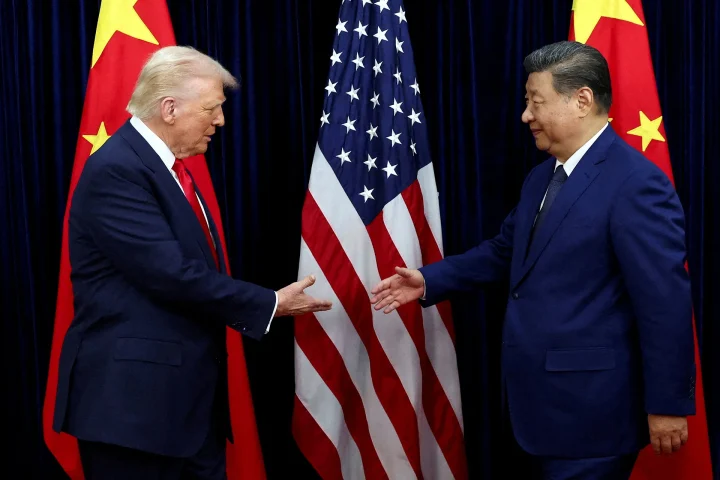


The Trump China tariffs 104% on Chinese imports have triggered sharp declines across global markets. Washington confirmed the duties would begin after midnight, sparking fears of a deeper recession. The size and timing of the tariffs added to market uncertainty and led to widespread investor panic.
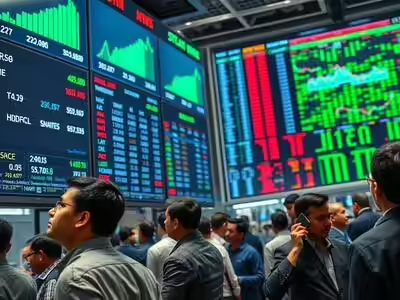
Wall Street experienced one of its steepest reversals in decades. The S&P 500 lost 4.2% after opening in positive territory. In just four days, the index shed $5.8 trillion in value — its worst performance since the 1950s. The Nasdaq and Dow also recorded heavy losses, reflecting growing investor fear.
Asian stocks mirrored the sell-off. China’s CSI300 dropped 1.2%, while Hong Kong’s Hang Seng fell 3.1%. Japan’s Nikkei tumbled 3.5%, erasing recent gains. In Taiwan, the TWII index slid 1.7% despite a $15 billion stabilization fund launched by the government.
The offshore yuan hit a record low of 7.4287 per dollar. The People’s Bank of China set the daily midpoint at 7.2066, the weakest since September 2023. President Trump accused China of devaluing its currency to offset the tariff impact. Analysts said China may be using the yuan as a tool to manage external shocks.
Safe-haven currencies rose as risk appetite declined. The U.S. dollar fell 0.6% to 145.36 yen and 0.5% to 0.8430 Swiss franc. The New Zealand dollar gained 0.3% after the Reserve Bank cut rates by 25 basis points to 3.5%. The bank also warned that global trade risks could hurt the local economy.
Bond markets showed mixed reactions. The 10-year U.S. Treasury yield rose 5 basis points to 4.335% as investors sold bonds to cover stock losses. In contrast, the 2-year yield dropped 6 basis points to 3.665% as markets priced in more Fed rate cuts.
Fed fund futures now point to a possible 115 basis points in cuts by year-end. That’s a big jump from Tuesday’s projection of 92 basis points. Traders expect the Federal Reserve to act fast if recession risks grow.
Oil prices plunged as fears of weaker demand from China increased. Brent crude fell 3.9% to $60.36 a barrel. U.S. crude dropped 4.4% to $56.96. These are the lowest prices in more than four years.
Gold failed to rise despite market stress. It slipped 0.2% to $2,039.76 per ounce. That’s the lowest level in a month. Analysts cited profit-taking and overall market strain as possible reasons.
Investors now await signs of progress between the U.S. and China. But neither side appears ready to compromise. Analysts warn that continued tension could slow the global economy and keep markets unstable.