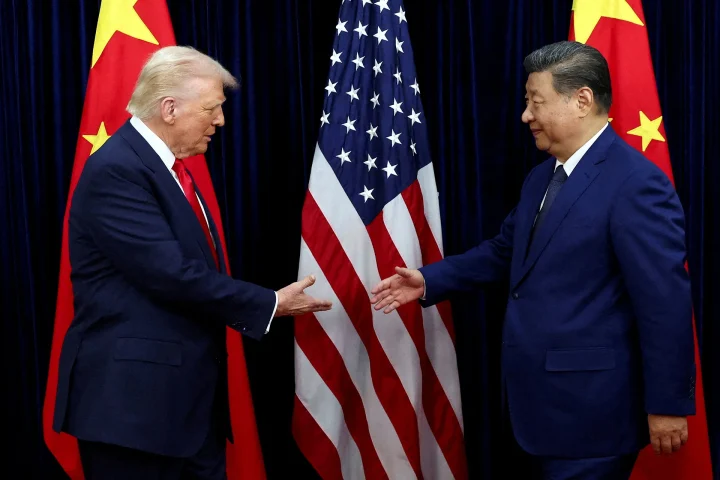


China has enacted new tariffs on American agricultural products in response to Washington’s latest 10% tariff hike on Chinese imports, signaling its readiness to counter any economic aggression from the U.S.
The move reinforces Beijing’s position that it will not yield to U.S. pressure tactics. President Donald Trump’s approach of using tariffs, sanctions, and strong rhetoric to force compliance has worked in some cases, as seen with Canada and Mexico, which sought trade concessions to avoid economic disruption. However, China is taking a different path, insisting on an equal footing in negotiations rather than seeking relief from Washington’s trade war threats.
Trump’s assumption that tariffs will pressure China into submission miscalculates the dynamics of the world’s two largest economies. Divergences between Beijing and Washington are inevitable, but the U.S. has made unrealistic demands, assuming its economic leverage remains unchallenged. Yet, the global balance of power has shifted.
According to the Center for Strategic and International Studies and the World Bank, China now holds the world’s second-largest nominal GDP and, when measured at purchasing power parity (PPP), its economy surpasses that of the U.S. The widely acknowledged shift in global economic influence challenges Washington’s ability to dictate terms. China has already made it clear that it will not engage from a position of weakness.
China’s Expanding Trade Influence
China’s economic rise is most evident in global trade dominance. The Lowy Institute found that 145 economies, representing 70% of the world, trade more with China than with the U.S. More than half of these economies conduct at least twice as much trade with China as they do with America.
Trump’s 2018 trade war failed to curb this trend. Instead, China’s trade lead over the U.S. has widened, making its economy less vulnerable to Washington’s tariff strategies.
Despite its firm stance, China remains open to negotiations. However, if forced into a prolonged trade conflict, it has the resources and confidence to fight until the end—and it believes it can outlast U.S. pressure. Trump’s strategy assumes the U.S. has more leverage, but the numbers tell a different story.
U.S. Agriculture Feels the Impact
China remains a critical market for American farmers, even as imports of U.S. agricultural products declined by 14% in 2024 after dropping 20% in 2023. This downward trend highlights China’s ability to shift its supply chains, but it hasn’t diminished its role as the largest buyer of U.S. farm goods.
The U.S.-China Business Council reports that American agricultural exports support more domestic jobs than any other sector. Tariffs on commodities like corn and soybeans will further redirect China’s reliance toward Brazilian suppliers, a shift that Saxo Bank’s commodity strategist Ole Hansen believes will create uncertainty for U.S. farmers making critical planting decisions.
Trump has touted tariffs as beneficial for American agriculture, but the reality is different. Farmers in red-state strongholds—his core voter base—are bearing the brunt of China’s retaliation.
Broader Economic Consequences for the U.S.
The tariff battle extends beyond agriculture. Blue-collar workers, another key Trump voting bloc, will also suffer as industries reliant on foreign trade and imports struggle with higher costs.
The American International Automobile Dealers Association warns that over 550,000 jobs in U.S. car dealerships tied to international brands are at risk if tariffs disrupt the auto industry. Meanwhile, the Peterson Institute estimates that import taxes on goods from China, Mexico, and Canada will cost the average American household an additional $1,200 per year.
With U.S. inflation already high and recession risks increasing, new tariffs will only exacerbate economic strain. According to the U.S. Bureau of Labor Statistics, the Consumer Price Index (CPI) rose by 3% year-over-year, adding pressure on American households.
S&P Global Ratings projects that Trump’s tariffs could add between 0.5% and 0.7% to U.S. consumer prices if they remain in place throughout the year. This rise in costs further weakens Trump’s negotiating position as his voter base feels the financial strain.
Trump’s Strategy Faces Growing Risks
Trump’s “Art of the Deal” approach assumes that China will ultimately capitulate under economic pressure. However, his administration underestimated China’s ability to absorb shocks, realign supply chains, and sustain economic resilience.
Had Trump carefully assessed China’s economic strength and global trade dominance, he might have reconsidered launching a trade war that increasingly appears to harm the U.S. more than its rival. As retaliatory tariffs take effect and inflation rises, his strategy may backfire politically and economically, leaving Washington with fewer bargaining chips than it initially thought.