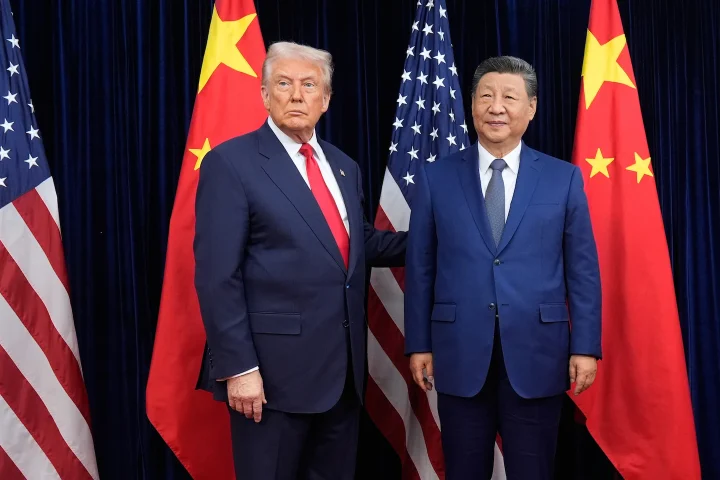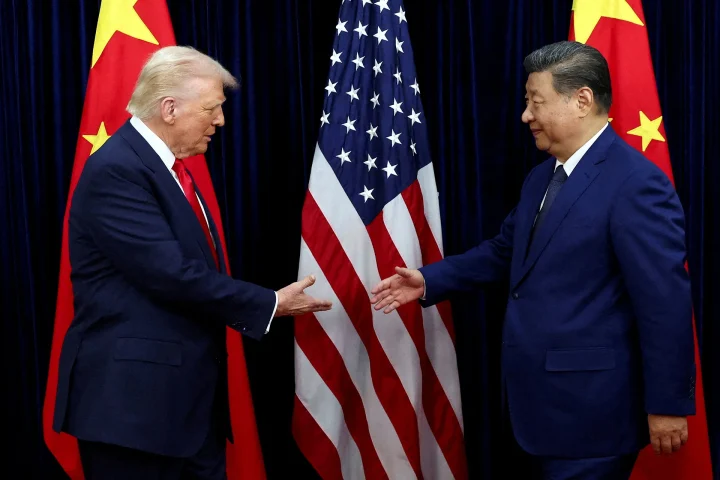


The Trump-Xi meeting has rekindled hopes for a new U.S.-China trade deal after months of escalating tariffs and economic uncertainty. Held on Thursday, the high-stakes talks brought together U.S. President Donald Trump and Chinese leader Xi Jinping in what Trump described as “a great success,” suggesting a deal could be signed “pretty soon.”
Both countries, which have been locked in disputes over tariffs, rare earth minerals, and semiconductor access, appear to have reached a broad consensus on easing trade tensions. Trump told reporters that Washington would lower tariffs on Chinese goods and that both sides had settled key issues related to rare earths and semiconductor cooperation. He also revealed that Beijing would begin direct talks with chip giant Nvidia, positioning the U.S. as a mediator.
Beijing’s official statement was more restrained, confirming only that both leaders agreed to resolve “major trade issues.” Analysts say that while optimism has returned, the truce remains fragile and heavily dependent on domestic pressures within both nations.
From Tariffs to Truce: A Painful Journey
The Trump-Xi meeting follows nearly a year of aggressive tit-for-tat tariffs that rattled global markets. Early in his second term, Trump imposed new levies on all Chinese imports, raising duties up to 20%. China retaliated with its own tariffs, pushing rates as high as 125%, hitting American exporters and farmers particularly hard.
China targeted U.S. soybeans and other agricultural goods to pressure Trump’s voter base, while American importers scrambled to find alternative supply chains. The global trade system felt the shockwaves as manufacturers faced delays, rising costs, and stockpiled goods.
By mid-year, both sides had agreed to a temporary truce, but fresh tensions over semiconductors reignited the conflict. Washington tightened export restrictions on advanced chips, limiting what U.S. companies could sell to China. Nvidia, a major player in the AI and chip industry, agreed to pay the U.S. government a 15% levy on China sales in exchange for export licenses — a move that Beijing viewed as excessive interference.
Rare Earths and Strategic Leverage
Another key flashpoint ahead of the Trump-Xi meeting was China’s decision to restrict rare earth mineral exports — essential for electronics, clean energy, and military technologies. The move caught Washington off guard, prompting emergency talks with allies including Japan, Australia, and Malaysia to secure alternative sources.
Experts note that while China holds a near-monopoly in rare earth processing, its own economy is under strain from slowing growth, weak consumption, and a real estate downturn. “Beijing wants to negotiate from a position of strength but can’t afford an endless trade war,” said Professor Tim Harcourt of the University of Technology Sydney.
Still, the rare earth standoff underscores how deeply interdependent the two economies remain. The U.S. relies on China for critical materials, while China depends on U.S. markets and advanced technology.
A Fragile Path Forward
While the Trump-Xi meeting has eased immediate tensions, economists warn that the underlying rivalry between the world’s two largest economies is far from resolved. China is doubling down on self-reliance, pouring billions into domestic tech and AI industries through giants like Alibaba and Huawei. The U.S., meanwhile, continues to forge strategic trade alliances to limit Chinese influence in global supply chains.
According to analysts, any agreement struck now will likely focus on short-term concessions — such as delaying tariffs or easing export curbs — while leaving deeper structural issues unresolved.
As one economist put it, this could be “a truce, not a transformation.” The Trump-Xi meeting may have bought time for both nations, but the road to lasting stability in global trade remains uncertain.