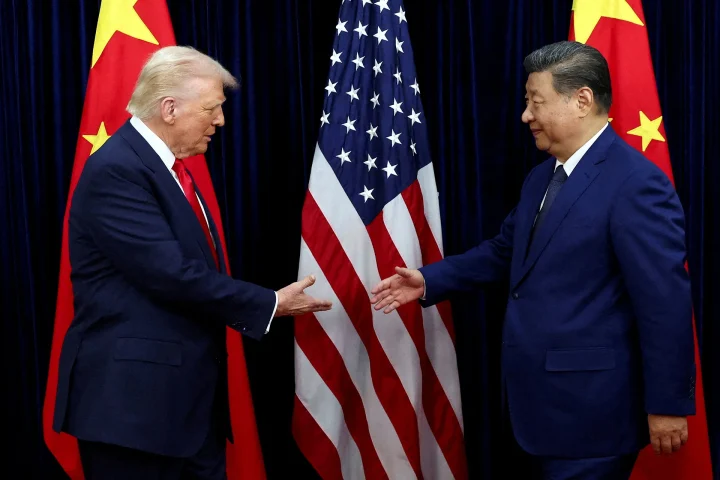


President Donald Trump announced a historic trade deal between the US and Japan. Under the agreement, Japan will invest $550bn in the US. Additionally, Japan’s goods will face 15% tariffs, which is lower than the 25% tariff Trump had previously threatened.
Trump shared the news on social media, stating that Japan would open its economy to US goods, including cars, trucks, rice, and agricultural products. This agreement marks a significant shift in US-Japan trade relations.
Trump said, “I just signed the largest trade deal in history, maybe the largest deal in history with Japan. They had their top people here. We worked on it long and hard. And it’s a great deal for everybody.”
Japan’s Prime Minister Shigeru Ishiba also welcomed the deal, calling it “the lowest figure to date among countries with trade surpluses with the US.”
The deal will reduce US tariffs on Japanese vehicles and parts from 25% to 15%. However, the new tax is still higher than the 10% Trump had previously imposed after suspending higher tariffs.
Japan’s automotive exports play a significant role in the country’s total exports to the US. The automotive sector accounts for 3% of Japan’s economy. In 2019, Japan’s automotive exports to the US reached $410bn. Ishiba noted that Japan became the “first in the world” to reduce tariffs on cars and auto parts without imposing quantity limits.
In comparison, UK cars exported to the US face a 10% tariff, but this is limited to a 100,000-vehicle quota. Therefore, the new deal will not reduce tariffs on goods entering Japan.
Despite these positive aspects, US automakers have expressed concerns. Matt Blunt, president of the American Automotive Policy Council, criticized the agreement. He described it as “a bad deal” for US manufacturers. While the deal reduces tariffs on imports from Japan, imports from Canada and Mexico will still face 25% tariffs.
In addition to the Trump-Japan deal, the US reached trade agreements with the Philippines and Indonesia. Both countries will face 19% tariffs on imports to the US. Indonesia will eliminate about 99% of tariff barriers on US goods. Meanwhile, the Philippines deal includes the removal of tariffs on US car imports.
Shigeto Nagai, from Oxford Economics, stated that the Japan deal is “the best compromise at this stage.” Furthermore, he noted that Japan’s investment in the US would support US manufacturing and create jobs.
Trump had previously threatened a 25% tariff on Japanese exports if the two countries did not reach a new deal by August 1, 2025. This followed Trump’s decision in April 2025 to delay higher tariffs for 90 days after market instability. This pause allowed Japan to negotiate with Washington.
Japan, the world’s fourth-largest economy, saw its stock market, represented by the Nikkei 225, rise by more than 3%. Major companies like Toyota, Nissan, and Honda reported strong gains.
Finally, this announcement comes as Prime Minister Ishiba faces pressure to resign. His Liberal Democratic Party (LDP) lost its majority in Japan’s upper house following the most recent elections.