
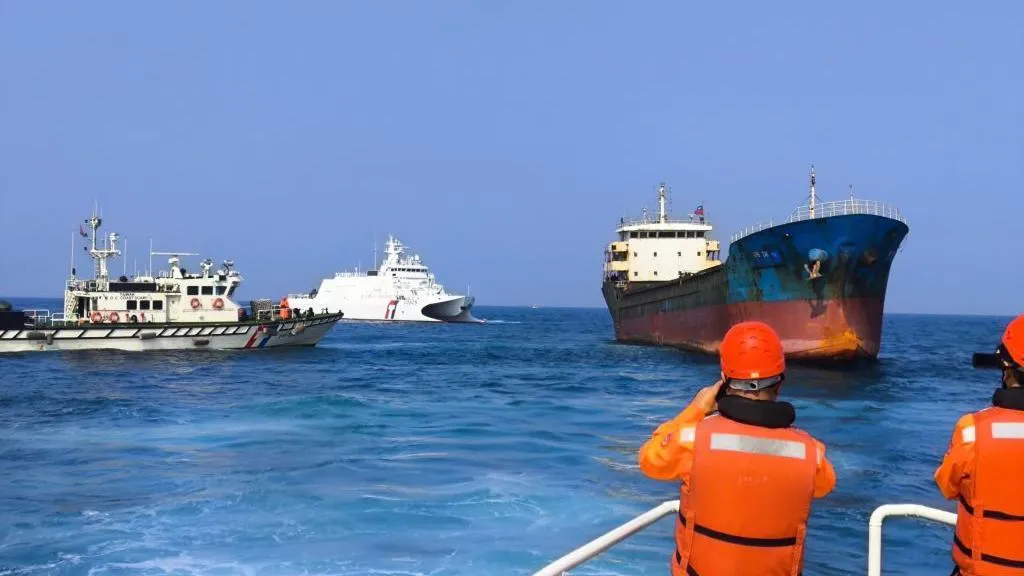
A court in Taiwan has sentenced a Chinese national to three years in prison for Taiwan undersea cable damage. This marks the first conviction tied to the growing concern over undersea sabotage near Taiwan. Mr. Wang, the captain of the Togolese-registered vessel Hong Tai 58, was found guilty of damaging a cable that connects Taiwan’s main island with the Penghu islands.
The Tainan District Court delivered its ruling on Thursday. Authorities said the damage severely disrupted public services and communications. As a result, they called for strict consequences. In February, Taiwan’s coast guard had tracked the vessel near its southern coast. Soon after Hong Tai 58 left the area, officials discovered the undersea cable had been cut. The coast guard brought the vessel back, detaining all eight Chinese crew members. However, only Mr. Wang stood trial.
Initially, he denied causing the damage. Eventually, he admitted that he “might have broken the cable.” According to him, the sea was rough, and he ordered the anchor dropped without realizing the area contained vital infrastructure. Nevertheless, prosecutors argued that the ship’s crew had access to navigational charts clearly showing cable zones. In their view, Wang’s decision was not an accident but a deliberate act of negligence.
Evidence presented in court strengthened that argument. The vessel’s anchor had been dragged directly across the seabed, unlike normal anchoring behavior. Moreover, the ship’s route aligned precisely with the location of the cable break. These details led the court to conclude that Wang’s explanation did not hold up under scrutiny.
Prosecutor Hsu Shu Han also cited several red flags. The Hong Tai 58 had only one recorded cargo trip in the past year. Furthermore, it was in poor condition, had changed names multiple times, and Wang could not identify the owner. While investigators found no evidence directly linking the case to Chinese authorities, the circumstances remained suspicious.
Taiwanese officials have long accused Beijing of using non-military tactics to pressure the island. These include acts like undersea cable disruption. China, however, dismisses the allegations, calling them exaggerated maritime incidents. Even so, Taiwan’s records show 36 cases of external undersea cable damage between 2019 and 2023. In January, Taiwan blamed another Chinese-owned vessel for damaging a northern cable, although the company denied involvement.
Undersea cables carry more than 95% of global internet traffic. Because of this, any disruption to them can severely affect communication, commerce, and government operations. Taiwan currently operates 10 domestic and 14 international cables. Officials are increasingly concerned that this infrastructure could become a target in rising geopolitical tensions.
To prevent future incidents, Taiwan’s Ministry of Digital Affairs and coast guard now monitor over 50 ships flagged for suspicious activity. Among these is the Hong Tai 58. Herming Chiueh, the deputy digital affairs minister, warned of the global implications. “Some scholars have said World War III could begin with the cutting of undersea cables,” he stated. “That’s quite realistic.” He emphasized the need for rapid reporting and secure systems to protect these critical links.
The Taiwan undersea cable damage case highlights how maritime infrastructure has become a new front in regional security. While direct state involvement was not proven, Taiwan continues to brace for more pressure from Beijing. With President William Lai adopting a harder stance and China increasing military drills, tensions around the island remain high.