

The political downfall of Yoon Suk Yeol marks one of the most dramatic collapses in modern South Korean political history. Once a prosecutor-turned-president with strong conservative backing, Yoon’s administration crumbled under relentless opposition, deepening public mistrust, and an unprecedented martial law declaration that triggered his ultimate impeachment.
From Prosecutor to President
Yoon Suk Yeol rose to national prominence through his tough-on-corruption stance as a prosecutor. He gained popularity for leading investigations into political and corporate elites, eventually winning the presidency in March 2022 under the conservative People Power Party (PPP).
His presidency began with promises of restoring integrity, boosting economic reforms, and taking a hardline stance on North Korea. But Yoon quickly encountered pushback, especially from the Democratic Party, which held a parliamentary majority and often stalled his legislative agenda.
Mounting Political Resistance
As president, Yoon faced increasing gridlock in parliament. Opposition lawmakers blocked major policies, launched multiple impeachment attempts against senior officials, and delayed key budget approvals.
Yoon’s approval ratings fell as public discontent grew over high living costs, youth unemployment, and his confrontational style. Critics accused him of being out of touch and overly aggressive in silencing dissent.
The Martial Law Miscalculation
The turning point in the political downfall of Yoon Suk Yeol came on 3 December 2024, when he made a shocking bid to invoke martial law. Claiming the need to eliminate “anti-state forces” and root out North Korea sympathizers, Yoon ordered military deployment and attempted to consolidate control over dissenting institutions.
The move backfired catastrophically.
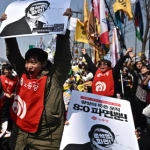
Thousands of South Koreans poured into the streets in protest. Opposition lawmakers physically stormed the National Assembly to block the martial law order. Among them was Democratic Party leader Lee Jae-myung, who livestreamed his call for public resistance, further rallying support.
Impeachment and Constitutional Court Ruling
As unrest surged and military compliance wavered, the National Assembly swiftly passed an impeachment motion against President Yoon. The motion cited unconstitutional use of power, abuse of executive authority, and endangerment of civil liberties.
On 4 April 2025, the Constitutional Court unanimously upheld the impeachment, officially removing Yoon from office. It was a landmark ruling that confirmed the president had violated his oath and acted beyond constitutional bounds.
Collapse of the People Power Party
The fallout from Yoon’s actions devastated the People Power Party (PPP). The party, already strained by internal divisions, was left leaderless and struggling to rebuild its public image. Several top party officials resigned, while others faced investigations for enabling the failed martial law attempt.
With trust in the PPP eroded, opposition candidates—especially Lee Jae-myung—gained momentum ahead of the June 3, 2025 election.
Legacy and Public Opinion
Yoon’s downfall intensified debates on executive overreach, democratic resilience, and political accountability in South Korea. Many citizens remain divided—some view him as a bold but misunderstood leader, while others see him as a symbol of authoritarian drift.
A poll conducted by the Hankyoreh newspaper in December 2024 found that over 50% of South Koreans believed the country was experiencing worsening political polarization, with Yoon’s government blamed for escalating tensions.
Conclusion
The political downfall of Yoon Suk Yeol is a cautionary tale about the limits of presidential power and the strength of democratic institutions. His failed martial law gambit, combined with widespread civil backlash and institutional resistance, ended a presidency that began with high hopes but collapsed under the weight of crisis and controversy.
For more context, explore our Lee Jae-myung’s election campaign .