

Myanmar Earthquake Devastates Muslim Community as Former Imam Grieves 170 lost loved ones.
When the deadly earthquake struck central Myanmar last Friday, it took the lives of hundreds mid-prayer—and left one man mourning nearly his entire community.
Soe Nay Oo, a former imam of Myoma Mosque in Sagaing, now living in exile in Thailand, lost an estimated 170 friends, family members, and congregants during the tremor that collapsed three of the city’s largest mosques during Ramadan’s final Friday prayers.
As he sat in his modest home in Mae Sot, Soe Nay Oo described the agony of learning that dozens who once prayed with him had perished under rubble. “I can’t stop the tears. I think of their children, of the prayers we shared. The grief is unbearable,” he said.
A Community Shattered
The 6.6 magnitude earthquake has so far claimed over 2,700 lives, with the death toll continuing to rise as rescue teams sift through ruins in Sagaing and nearby Mandalay.
Sagaing’s Myoma Street, home to several mosques, was one of the worst-hit areas. Worshippers were crushed in collapsed buildings, while hundreds more are left homeless, sleeping along roadsides amid scarce food supplies and fears of aftershocks.
More than 500 Muslims reportedly died during prayers, including elders, children, and respected leaders of the city’s tightly knit Muslim population.
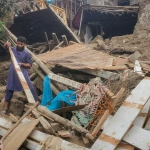
Photos shared with Soe Nay Oo show Myoma Mosque reduced to rubble—only fragments of walls standing, while mangled steel and shattered concrete litter the site.
A Personal Loss Too Deep to Bear
Among those killed was a cousin of his wife, whose death he described as “the most painful moment” of his life. “She was full of love. The entire family adored her.”
He also lost a former assistant imam, a man known for his devotion and melodic Quran recitation, and a prominent businessman who had completed the Hajj pilgrimage and called Soe Nay Oo his “little brother.”
Another casualty was the female trustee of the mosque and school principal, known for her selfless contributions to mosque activities.
“Even those not related by blood were like family,” he said, his voice breaking. “They welcomed me into their lives, followed my prayers. Now they’re gone.”
Martyrs of Ramadan
Soe Nay Oo believes those who perished during Friday prayers in the holy month of Ramadan will be remembered as martyrs in the eyes of Islam. “They have returned to Allah’s home,” he said with reverence.
But the tragedy has been compounded by logistical and political challenges. With the local Muslim cemetery inaccessible due to military conflict near PDF-controlled areas, families have had to transport bodies across the Irrawaddy River to Mandalay for burial. Some remain unburied, defying Islamic tradition of burial within 24 hours.
“It is the saddest thing—for Muslims not to bury their own at the end,” he said.
Survivor’s Guilt and a Mission to Help
Now working with a human rights organization in Thailand, Soe Nay Oo has temporarily put his job on hold to help coordinate relief efforts for survivors in Sagaing. He estimates at least 1,000 Muslims remain in urgent need of assistance.
Haunted by the tragedy, he confessed to feeling survivor’s guilt. “If I had still been the imam, I would have been with them. That’s something I could have accepted.”
His grief is compounded by the silence from missing family members, including siblings in Mandalay.
“I haven’t slept in days,” he said, sobbing. “This feeling—this sorrow—I’ve never known anything like it. I’m not a man who cries easily. But this pain is beyond words.”