
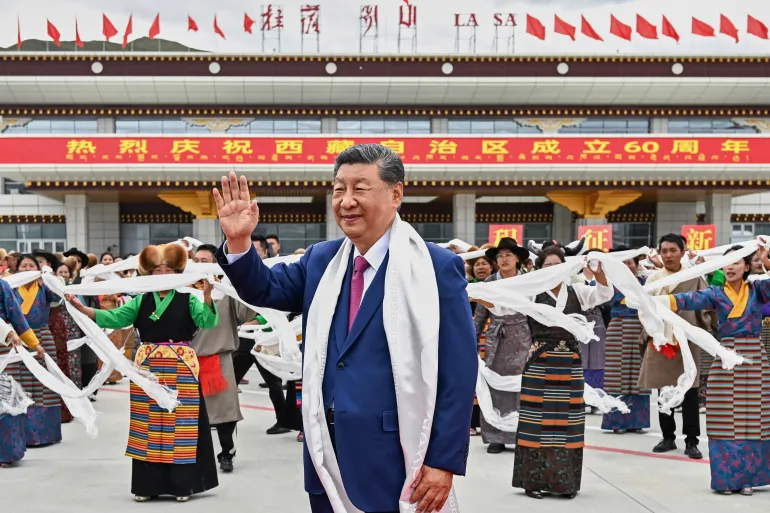
In a surprise visit to Tibet, President Xi Jinping urged unity and development, marking 60 years since China established the Tibet Autonomous Region after its annexation. The visit to the capital city of Lhasa comes as tensions continue over Tibetan autonomy and human rights issues.
Xi’s Speech on Unity and Stability
Xi’s visit to Tibet, his second as president, focused on political stability and ethnic unity. Speaking before a crowd of 20,000, he praised the Tibetan government for its efforts to combat separatism, a longstanding issue in the region. His comments were strategically timed after the Dalai Lama’s office declared it would choose the spiritual leader’s successor, a move opposed by Beijing, which insists on controlling the decision.
In his address, Xi emphasized that maintaining political and social stability, religious harmony, and ethnic unity were crucial for Tibet’s governance and development.
The Dalai Lama and Tibet’s Spiritual Future
Xi’s speech notably excluded any mention of the Dalai Lama, who has been in exile since fleeing to India in 1959. The Chinese government’s rejection of his influence, combined with its stance on choosing his successor, continues to strain relations between Tibet and Beijing. The Dalai Lama’s “middle way” approach calls for genuine self-rule within China, which Beijing considers separatist.
The visit comes amid growing international concern over China’s human rights record in Tibet, with accusations of cultural and religious suppression. Tibetans have raised alarm over restrictions on their practices and freedoms, which human rights groups say have been steadily eroded by Beijing’s policies.
Xi’s Push for Development and Religious Control
During his visit, Xi also focused on economic development and environmental protection in Tibet. He outlined plans for expanding infrastructure and improving living standards, claiming that Tibetans have benefited from China’s rule.
However, China’s policies in Tibet, including the imposition of Mandarin Chinese in schools and stronger regulations on religious affairs, have faced significant opposition. Xi called for Tibetan Buddhism to “adapt to socialist society,” a statement that many see as an effort to control and restrict religious freedoms in the region.
The Motuo Hydropower Dam and Environmental Concerns
Xi’s visit coincided with the start of construction on the Motuo Hydropower Station, the world’s largest dam, which will be located on the Yarlung Tsangpo river in Tibet. While Beijing frames the project as essential for local prosperity and ecological protection, concerns persist over China’s control over the river, which flows into India and Bangladesh. This massive dam is expected to reshape the region’s water resources, potentially heightening tensions with neighboring countries.
Conclusion: Xi’s Visit and Tibet’s Future
Xi Jinping’s visit to Tibet underscores China’s ongoing efforts to solidify control over the region. While presenting an image of development and harmony, the visit also highlights the enduring challenges of Tibetan autonomy and religious freedom. As Beijing continues its policies in Tibet, the international community watches closely, with many questioning whether these actions will lead to lasting peace or further tensions in the region.