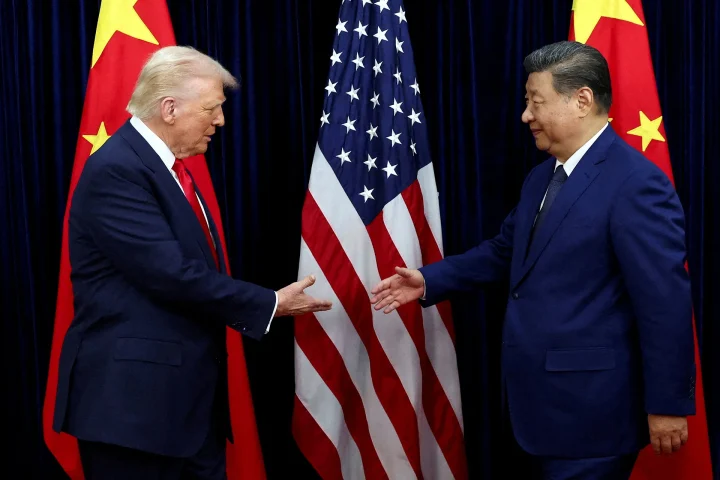


Beijing issued a sharp response on Thursday following Trump’s new tariffs on China, calling for the United States to cancel the sweeping levies immediately. China’s Commerce Ministry accused the U.S. of ignoring trade negotiation outcomes and benefiting unfairly from global trade systems over the years.
“China firmly opposes this and will take countermeasures to safeguard its own rights and interests,” the ministry stated. With both economies escalating their standoff, a new chapter in the U.S.-China trade war seems imminent—threatening global supply chains.
President Donald Trump announced on Wednesday that China would face a new 34% tariff, added to an earlier 20% rate. This brings the total tariff burden on Chinese imports to 54%, nearing the 60% he once proposed during his campaign.
Under the new plan, a 10% baseline tariff will apply to nearly all goods from China starting Saturday. The remaining reciprocal tariffs will begin on April 9. Trump also signed an executive order eliminating the “de minimis” rule. This loophole had previously allowed low-value Chinese packages to enter the U.S. without duties.
Additionally, Trump directed the U.S. Trade Representative to evaluate whether China honored its obligations under the 2020 Phase 1 agreement by April 1. The deal required China to increase purchases of U.S. goods by $200 billion. However, the COVID-19 pandemic disrupted those goals. Chinese customs data shows that exports from the U.S. to China rose from $153 billion in 2017 to just $164 billion in 2023—well below the deal’s targets.
Trade experts warn that Trump’s tariffs could cause more disruption outside China. “Arguably, President Trump’s tariffs elsewhere will cause the most headaches,” said Ruby Osman from the Tony Blair Institute. She explained that Chinese exporters often reroute products through Vietnam and Mexico, but these countries now face tariffs as well.
In fact, Trump’s tariff sweep targets nations like Vietnam, Mexico, India, and Malaysia, with levies ranging between 24% and 46%. These countries had benefited from the “China+1” strategy—an effort by companies to diversify manufacturing away from China. But with their cost advantage eroding, many firms may rethink relocation strategies.
While the tariffs hurt Chinese exporters, experts say the broader Chinese economy might not suffer significantly. “U.S. exports are of declining importance to China,” noted William Hurst from the University of Cambridge. “This will push China to expand trade with Europe, Southeast Asia, and Africa.”
Still, Chinese producers call shifting to new markets a “rat race.” Price wars are increasing among exporters, further squeezing profit margins. This pressure risks amplifying deflationary trends in an economy already focused on post-COVID recovery.
Despite the growing trade risk, China maintained its economic growth target at around 5% for the year. The government plans more fiscal stimulus, higher debt issuance, and greater support for domestic consumption to soften the blow.
Ruby Osman noted that China had anticipated such a move. “Beijing’s moderate stimulus announcements in March weren’t an oversight,” she said. “They’ve kept tools in reserve, ready to respond more forcefully if needed.”
As tensions escalate, a potential face-to-face between President Trump and President Xi Jinping could take place in June. According to Craig Singleton from the Foundation for Defense of Democracies, both leaders are locked in a cycle of pressure and pride.
“Trump mixes pressure with sudden offers of diplomacy,” Singleton said. “Xi, on the other hand, moves slowly and cautiously. If he engages too early, he looks weak. If he waits too long, the pressure builds.”
With no side willing to blink first, analysts fear a prolonged standoff. The global economy now braces for the ripple effects of Trump’s new tariffs on China, which may be just the beginning of a broader decoupling between the world’s two largest economies.