
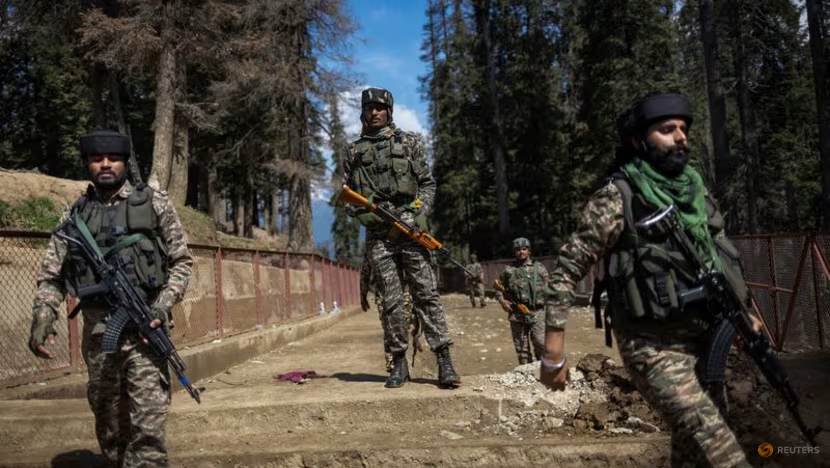
India-Pakistan Kashmir Tensions Flare Again After Deadly Attack
New Delhi | May 3, 2025
A deadly militant attack in Pahalgam, Indian-administered Kashmir, that killed 26 civilians has triggered a renewed diplomatic and military crisis between India and Pakistan, mirroring earlier escalations such as the 2019 Pulwama bombing and 2008 Mumbai attacks.
The strike on tourists — as opposed to soldiers — marked a chilling shift in the pattern of violence and heightened public outrage across India.
A Familiar Escalation Pattern
In response, India shut down key diplomatic and transport ties:
- Closed the Wagah border crossing
- Suspended the Indus Waters Treaty cooperation
- Barred Pakistani nationals from entry and revoked most visas
- Expelled diplomats
- Denied airspace access to all Pakistani aircraft
Pakistan retaliated by mirroring airspace restrictions, suspending visas, and terminating a longstanding peace treaty.
This tit-for-tat exchange rekindles the high-stakes crisis atmosphere seen during Pulwama, where a suicide bombing claimed 40 paramilitary lives, prompting Indian airstrikes in Balakot — the first such incursion into Pakistan since 1971.
Lessons from the Past: Ajay Bisaria’s Memoir
Ajay Bisaria, India’s former high commissioner to Pakistan, compares the current moment to Pulwama and Mumbai. In his book Anger Management, he outlines the rapid hardening of India’s diplomatic stance during past crises.
Following Pulwama:
- India revoked Pakistan’s “most-favoured-nation” trade status
- Imposed 200% tariffs
- Halted cross-border transport (Samjhauta Express, Delhi-Lahore bus)
- Stopped bilateral dialogues and suspended the Kartarpur corridor discussions
- Campaigned for UN sanctions against Jaish-e-Mohammad (JeM) and its leader Masood Azhar
Bisaria reflects, “Trust built over years was erased in minutes.”
Limited Space for Diplomacy
Despite the harsh responses, backchannel communications stayed open. DGMOs remained in contact, and high commissions kept working, even as public and media pressure demanded retaliation.
During Pulwama, India’s measured but tough approach eventually led to the return of IAF pilot Abhinandan Varthaman, captured after a jet was downed during the 2019 dogfight. Pakistan’s decision to release him under POW protocols helped cool tensions.
A similar “dual-track” strategy of escalation and restraint is unfolding now. India is reportedly re-evaluating 48 bilateral agreements, and the Indus Waters Treaty — a decades-old river-sharing accord — is under fresh scrutiny. If revoked, it could mark a historic shift in South Asian geopolitics.
What Comes Next?
For now, no full-scale military confrontation has occurred, but troops on both sides have exchanged small-arms fire across the Line of Control. Experts warn that any kinetic action could tip the crisis into open conflict.
Bisaria concludes: “We’re still in crisis mode. The instinct to de-escalate competes with the urge to retaliate.”