
China has stepped up construction activity at Antelope Reef in the South China Sea, deepening regional tensions and sharpening debate over whether US military power can still decisively counter Beijing’s expanding maritime footprint. New satellite imagery shows fresh dredging and land reclamation, reinforcing concerns about China’s long-term strategy to consolidate control over contested waters. China Dredging at Antelope Reef Raises South China Sea Tensions
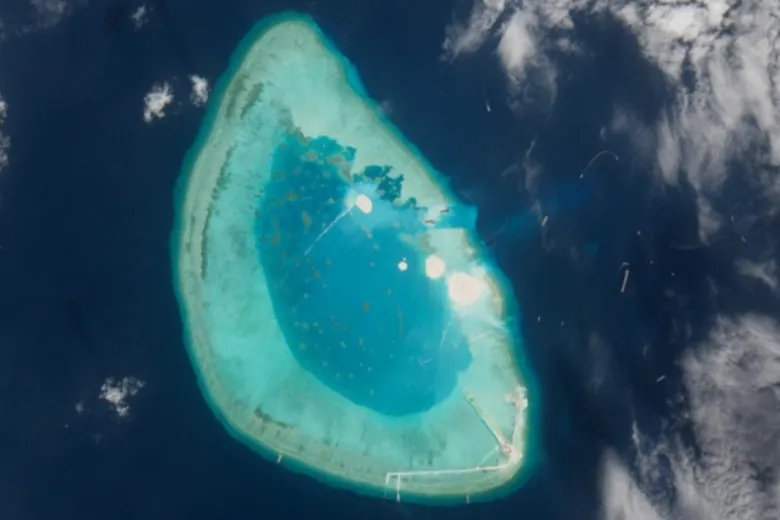
According to recent reports, China began renewed dredging at Antelope Reef in October, adding new land along the eastern and southern edges of the lagoon. The reef, also known as Linyang Jiao in China and Da Hai Sam in Vietnam, lies in the western Paracel Islands, east of central Vietnam and southeast of China’s naval base on Hainan Island. Images from European Space Agency satellites show expanding sand deposits around an existing outpost and port facility.
China has controlled the Paracel Islands since 1974 and claims most of the South China Sea, a critical maritime corridor that carries a significant share of global trade. Analysts say the latest activity fits a broader pattern of island-building that supports surveillance, electronic warfare, and military logistics across the region.
The buildup at Antelope Reef comes as Vietnam accelerates its own reclamation efforts in the Spratly Islands, adding to regional friction. However, Vietnam has historically calibrated its responses carefully to avoid severely damaging ties with Beijing. Research groups previously classified Antelope Reef as little more than a sandbar, but the growing presence of construction materials and infrastructure suggests it is being transformed into a functional military node.
Strategically, Antelope Reef could serve as a forward site for helipads, warship anchorage, and maritime law enforcement operations. Its proximity to Hainan allows for easier resupply while enhancing redundancy and overlap in China’s surveillance and anti-access capabilities. These include signals intelligence, electronic warfare systems, and potentially missile deployments designed to restrict adversary movement.
In a broader tactical context, Chinese military analyses have highlighted how outposts in the South China Sea provide all-weather situational awareness and enable continuous monitoring of foreign military forces. By expanding smaller features like Antelope Reef, China strengthens a dispersed network that complicates efforts by rival claimants to challenge its presence, effectively reinforcing de facto control.
However, the durability of these outposts in wartime remains contested. US assessments have long argued that Chinese island bases would be vulnerable in a high-end conflict, particularly if a confrontation over Taiwan spills into the South China Sea. Advances in precision-strike technologies could make fixed installations easier to target, at least in theory.
At the same time, analysts caution that neutralizing China’s island network could prove far more difficult and costly than expected. China has invested heavily in rapid runway repair, airfield recovery, and military-civil fusion capabilities, allowing damaged facilities to resume operations quickly. Exercises emphasize debris removal, crater repair, and rapid resurfacing, although real-world effectiveness under sustained attack remains uncertain.
There is also the issue of cost and capacity. Experts warn that destroying China’s major island outposts could require hundreds of long-range missiles, potentially straining US stockpiles needed for more critical theaters near Taiwan and Japan. With missile production constrained by long timelines, a prolonged conflict could test US sustainment and deterrence.
As dredging continues at Antelope Reef, the development underscores a shifting strategic reality in the South China Sea. Rather than dramatic confrontations, China’s incremental construction is steadily reshaping the military balance, forcing the United States and regional players to reassess assumptions about escalation, deterrence, and control in a potential future conflict.